A Multimillion-Dollar Ad Campaign Audit
We were hired to audit a large ecommerce brand's paid search ad campaigns. Here’s what we did, what we found and what we recommended.

A large online retailer of custom-made products with an expansive catalogue came to us for an audit of their paid search ads. They asked us to identify waste, growth opportunities, and optimization levers for their non-branded campaigns.
We worked on a fixed fee, with read-only access to Google Ads, Google Analytics, Google Search Console, Merchant Center, Microsoft Advertising, and internal data provided by the client. Here’s what we did and what we found.
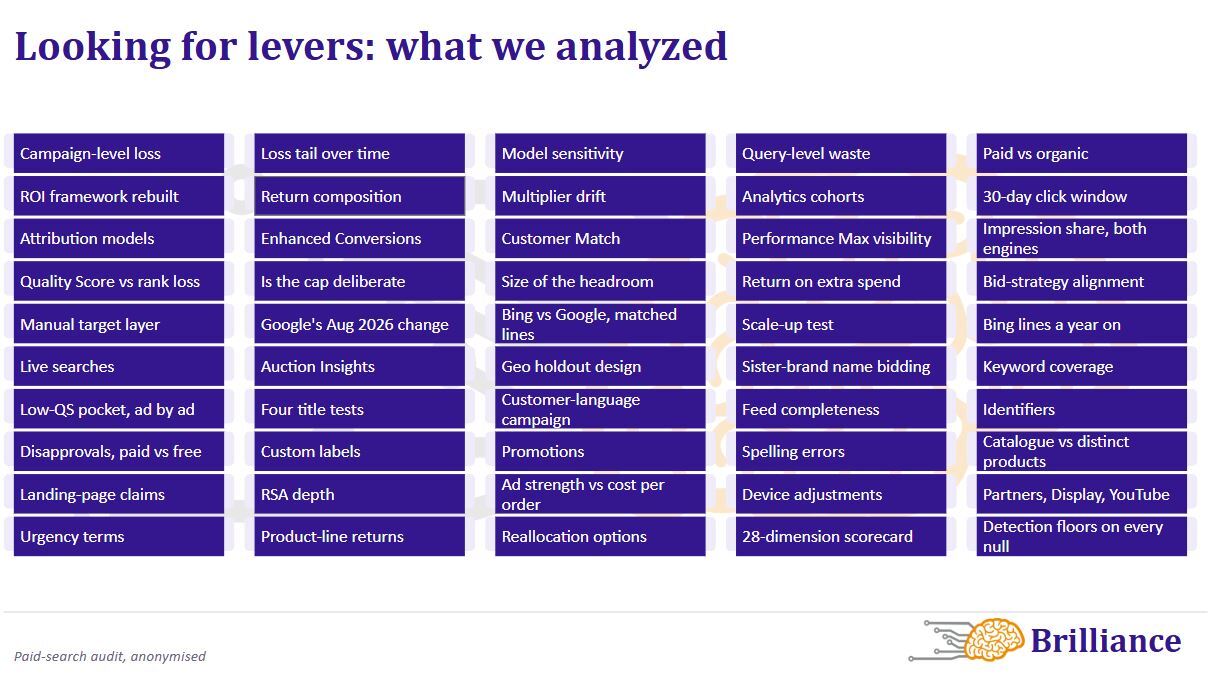
We ran 50 distinct tests and over 90 checks during the audit. The client’s ads run on Google and Bing, across Search, Shopping and Performance Max, at roughly $2M a month across 250+ campaigns. The program is measured on the team's proprietary lifetime-value (LTV) model.
We started with the team's own weekly campaign export: over 15,000 campaign-weeks across an 18-month window, over 7 million search terms, the full product feed, Auction Insights, impression share, Quality Score and ad change history. We derived acquisition cohorts from their analytics during the access window.
As a primary safety check, we rebuilt the team's ROI framework from the weekly rows. It reproduced their own ROI column exactly, with zero residual.
Every test and check was rerun at least twice — often 3-5 times — before we used any data point.
We won’t detail everything we did to protect the client’s anonymity – plus it’s way too much data for this case study – but here are three examples.
Looking for Waste
One of the first things we did was check for wasted spend. Here’s a summary of what we did:
- We tested every campaign’s modelled return against its own spend, then asked how far the internal LTV model would have to overstate customers before that verdict changed.
- We scanned two million search terms for spend with no return against query cost.
- We checked whether paid non-brand spend was buying searches the site already won organically.
- We followed the loss-making campaigns quarter to quarter to see whether the team was clearing them.
The scorecord
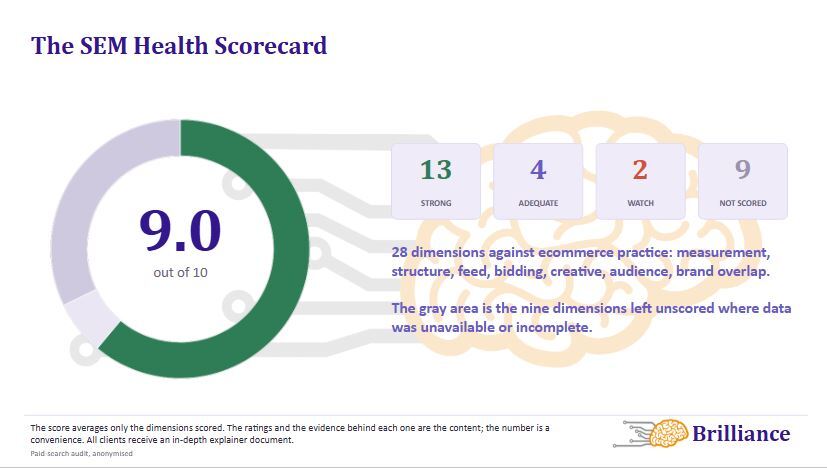
One of our audit’s features is the scorecard, which measures 25 to 30 different dimensions to score the overall campaign’s health. It covers:
- Conversion measurement: tag coverage, deduplication, value accuracy and attribution model.
- Campaign structure: segmentation logic, PMax/Search Shopping balance.
- Cannibalization within sister campaigns, brand specializations & overlap.
- Shopping feed: feed completeness, title quality, disapproval rate, price competitiveness, custom-label segmentation.
- Bidding: strategy alignment between bidding platforms, target accuracy, loss-making spend, bidding consistency, demand capture within their ad sales (A/S) cap.
- Ad creative: Responsive Search Ads (RSA) coverage, asset strength distribution, copy-to-intent match, extension/asset completeness.
- Audience & Targeting: device & demographic bid adjustments, RLSA/remarketing coverage, customer match utilization.
Putting titles to the test
To see whether product titles could be a lever, we used AI-assisted scripting to run four tests against two million search terms and the full product feed:
- Does a better title make a product sell better?
- Is anything in the catalog failing to serve demand?
- Do the titles contain the words customers convert on?
- Would adding those “missing” words improve anything?
These hypotheses came up negative. Title modifications were not a lever we could recommend.
Were sister campaigns eating into profit?
Our client has sister brands also running ad campaigns for similar products. We used platform reports and ran a few dozen real-time searches to document if and where the brands were meeting. They were – but would changing strategies help?
This was not a simple yes or no question, so we proposed a test the team could perform themselves.
Our Recommendations
The action plan had ten specific items. These were our top three recommendations:
- Raising the ad sales (A/S) cap is a high-level decision. We had an entire slide on the cases for and against raising the A/S cap to assist their future decision, and recommended specific campaign lines to move the money to if the cap increases.
- We recommended re-allocating a tenth of the lowest-returning large line toward the three strongest, and read the result against the same season a year earlier.
- We recommended they run a 12-week geo holdout test to see to learn whether sales shared with a sister brand are incremental. Both this and the above recommendation were advised to be done after peak seasons so as to not disrupt a major sales period.
Deliverables produced
The client received:
- A 20-slide PowerPoint deck along with a presentation to explain our findings and field questions.
- An evidence workbook. Every data point was built from the same files to eliminate discrepancy and for the team to be able to reproduce our findings.
- A separate in-depth scorecard document with all ratings explained in plain language.
- A prioritized action plan document with next steps.
Collaborative, transparent delivery
Stakeholders described our process as friendly, engaging, and focused on outcomes, not just transactions. We use visual examples to align quickly and keep feedback concrete, so decisions come faster and the work gets better.
- $60,000/year in platform licensing eliminated by moving off Magento and freeing budget for content, campaigns, and continuous improvement
- Marketing-first publishing with Craft CMS: faster updates, easier iteration, and tighter control over brand presentation
- A modern, animation-enhanced frontend that reflects Bob’s Red Mill’s reputation and warmth. All without compromising usability
- High internal satisfaction: the marketing team praised the new site experience and the collaboration that got it there
Wondering how your ads are doing? Give us a call.
An audit from Brilliance tells you what your data shows, including when the answer is “this is working.” Every number or data point gets produced at least twice before we trust it.
A Brilliance audit has a fixed fee and typically lasts about four weeks. We look at every angle to see how your campaigns are performing and to identify any area of opportunity for growth or efficiency.
Before the audit, we’ll meet and listen to what you’re looking to achieve. Throughout the audit, we’ll check in with you to ask questions, field questions, and provide updates.
At the audit’s end, we’ll present you with our findings, explain them, and field any questions. You’ll get a set of deliverables: a health scorecard with 20+ dimensions, a prioritized action plan, an evidence workbook and the final slide deck. Our findings are written in plain language, so you won’t need a marketing dictionary.
Continue reading.

From Expensive eCommerce Frustrations to a Flexible, Marketing-First Website
Read more
This trendy commercial real estate company went for a full rebrand, and the results were fantastic.
Read more
Let's chat about your project
Ste 700
Portland, OR 97214
